Los Angeles Tickets

Visit Natural History Museum of LA County

The Natural History Museum of Los Angeles County is a large museum in Exposition Park best known for its dinosaur fossils, gem collections, and Southern California nature exhibits. It is easy to enjoy, but it is not a quick in-and-out stop if you want more than the headline halls. The biggest difference between a rushed visit and a good one is whether you plan your route before you enter. This guide covers timing, tickets, arrival, and what to prioritize first.

Quick overview: Natural History Museum of Los Angeles County at a glance

If you want an easy museum day in Los Angeles, decide your arrival time and top exhibits before you go.

  • When to visit: Monday-Sunday: 9:30am-5pm. Right at opening or after 3pm is noticeably calmer than late morning, and Wednesday-Friday mornings often fill early with school groups heading straight for Dinosaur Hall.
  • Getting in: From $18 for standard entry. Timed General Admission is the main option, and booking ahead matters most on weekends, school-break dates, and free late-afternoon resident hours.
  • How long to allow: 3-4 hours for most visitors. It pushes toward the longer end if you add Nature Lab, read the interpretation in Becoming Los Angeles, or stay for a free guided program.
  • What most people miss: NHM Commons before the main building, plus the smaller details in Gem and Mineral Hall and Becoming Los Angeles that sit outside the dinosaur rush.
  • Is a guide worth it? A paid guide is not essential here, but the museum's free daily Dinosaur Hall tour adds real value if you want context without giving up the rest of your visit.

Jump to what you need

🕒 Where and when to go

Hours, directions, entrances and the best time to arrive

🗓️ How much time do you need?

Visit lengths, suggested routes and how to plan around your time

🎟️ Which ticket is right for you?

Compare all entry options, tours and special experiences

🗺️ Getting around

How the galleries are laid out and the route that makes most sense

🦖 What to see

Dinosaur Hall, Gem and Mineral Hall, Nature Lab

♿ Facilities and accessibility

Restrooms, lockers, accessibility details and family services

Where and when to go

How do you get to Natural History Museum of Los Angeles County?

The museum sits inside Exposition Park, a short walk from Expo Park/USC Station and a quick ride south of Downtown Los Angeles.

900 Exposition Blvd, Los Angeles, CA 90007, United States

→ Open in Google Maps

  • Metro: Expo Park/USC Station (E Line): about 5 min on foot, with the easiest approach through Exposition Park toward NHM Commons.
  • Bus: Vermont/Exposition: about 4 min on foot, useful if you are connecting from central Los Angeles without driving.
  • Rideshare: Bill Robertson Lane drop-off: closest for the main entrance and simplest if you are arriving with kids.
  • Parking: NHM Parking Garage: flat daily rate parking at Bill Robertson Lane, and it is usually the least complicated option if you are driving.

Full getting there guide

Which entrance should you use?

There is one main public entrance, and the part people get wrong is assuming an advance ticket skips the full line. It skips the ticket counter, not the security checkpoint.

  • Main entrance: Located at NHM Commons off Bill Robertson Lane. Expect 10-15 min waits on regular weekdays and 20-45 min during weekend late mornings and school-break periods.

Full entrances guide

When is Natural History Museum of Los Angeles County open?

  • Monday-Sunday: 9:30am-5pm
  • First Tuesday of most months: closed
  • Major holidays: closed
  • Last entry: 4pm

When is it busiest? Weekend late mornings, plus Wednesday-Friday mornings during the school year, usually feel most crowded because field trips and family visits overlap in the dinosaur and nature galleries.

When should you actually go? Monday at opening or after 3pm usually gives you more breathing room in Dinosaur Hall before the biggest midday wave builds or after it thins out.

How much time do you need?

Visit typeRouteDurationWalking distanceWhat you get

Highlights only

NHM Commons → Dinosaur Hall → Gem and Mineral Hall → exit

2-2.5 hrs

~0.8 km

You see the signature fossils and gems, but you will skim or skip Becoming Los Angeles, Nature Lab, and the quieter diorama halls.

Balanced visit

NHM Commons → Dinosaur Hall → Gem and Mineral Hall → Becoming Los Angeles → Nature Lab → exit

3-4 hrs

~1.2 km

This is the best first visit because it covers the major halls plus one strong local-history and one interactive stop without turning the day into a slog.

Full exploration

NHM Commons → permanent halls on all levels → Nature Lab → family spaces → seasonal add-ons if booked → exit

4+ hrs

~1.8 km

You get the museum at a slower pace, including smaller details most people miss, but it is a longer indoor day and families usually need food and rest breaks.

Which Natural History Museum of Los Angeles County ticket is best for you

Ticket typeWhat's includedBest forPrice range

General Admission

Entry to Natural History Museum of Los Angeles County + behind-the-scenes access with scientists + viewing of real fossil preparation and storage + storytelling about the Museum's iconic dinosaurs

A flexible first visit where you want permanent highlights and a little extra context without committing to a fixed group route

From $18

How do you get around Natural History Museum of Los Angeles County?

The museum is spread across older historic halls and newer visitor spaces, so it feels more multi-wing than linear. It is easy to self-navigate for the headline galleries, but it is also easy to miss whole sections if you head straight for the dinosaurs and never reset your route.

Museum layout and suggested route

  • NHM Commons: Entry plaza, visitor services, and the first big orientation point with Gnatalie and the mural; budget 10-15 min.
  • Main rotunda and Dinosaur Hall: The core fossil experience and the museum's biggest draw; budget 45-60 min.
  • Gem and Mineral Hall: Dense but compact, with standout specimens and easy stop-and-go pacing; budget 20-30 min.
  • Becoming Los Angeles and upper galleries: Regional history, culture, and quieter exhibits; budget 25-40 min.
  • Nature Lab and family spaces: Best for hands-on breaks and younger visitors; budget 20-30 min.

Suggested route: Start in NHM Commons, go to Dinosaur Hall before the late-morning crush, then cross to Gem and Mineral Hall, move upstairs for Becoming Los Angeles, and finish in Nature Lab when you are ready for a more interactive stop.

Maps and navigation tools

  • Map: Download or pick up the museum map for galleries, restrooms, and family spaces before you start from NHM Commons or visitor services.
  • Signage: Good enough for major halls, but a map genuinely helps if you want to fit in Nature Lab, Becoming Los Angeles, and the quieter upper-level rooms without doubling back.
  • Audio guide / app: There is no essential paid audio layer to rely on here, and the free Dinosaur Hall tour adds more value than wandering that section cold.

💡 Pro tip: Do not treat NHM Commons as just the lobby. It is the easiest place to orient yourself before the old building branches into bigger halls and quieter side galleries.

Get the Natural History Museum of Los Angeles County map / audio guide

Where are the masterpieces inside Natural History Museum of Los Angeles County?

Dinosaur Hall at NHM Los Angeles
1/7

Dinosaur Hall

Exhibit type: Fossil gallery

This is the museum's anchor space, with towering skeletons arranged in a way that feels dramatic even if you have visited natural history museums before. The reason to slow down is not just size, but the quality of the specimens and how the hall shows different periods of dinosaur life. Many visitors rush the edges of the room and miss smaller fossils that explain how scientists actually build the bigger story.

Where to find it: Main rotunda area inside the historic museum building

T. rex growth series

Exhibit focus: Paleontology and life stages

The T. rex sequence is one of the most memorable parts of the museum because it shows baby, juvenile, and adult specimens together instead of treating the species as one single giant skeleton. It is worth pausing here because the comparison makes size, growth, and behavior far easier to grasp. Most visitors photograph the largest skeleton and move on too quickly to notice how much the juvenile changes the story.

Where to find it: Inside Dinosaur Hall, near the central fossil displays

Gem and Mineral Hall

Exhibit type: Mineral and gemstone collection

This hall is quieter than the dinosaurs, which is exactly why it deserves more of your time. You get meteorites, gold, gemstones, and fluorescent minerals, but the real payoff is how varied the collection feels from case to case. Many visitors do a fast lap and miss the darkened sections and the smaller specimens that are more unusual than the biggest sparkling pieces.

Where to find it: Level 1, in the east wing galleries

Mojave Nugget

Specimen type: Gold specimen

The Mojave Nugget is easy to appreciate even if geology is not usually your thing because its scale is instantly impressive. It is one of those objects that works as both a headline piece and a useful pause point in a dense hall full of details. People often remember the size but miss how it changes the pace of the room, making the surrounding cases easier to explore with more patience.

Where to find it: Inside Gem and Mineral Hall

Becoming Los Angeles

Exhibit type: Regional history and ecology

This is the permanent gallery that gives the museum its local character. Instead of repeating what you can see in many other natural history museums, it connects Southern California's landscapes, wildlife, people, and development into one story. Many visitors skip it because it is less visually loud than Dinosaur Hall, but it is one of the best places to understand why this museum feels grounded in Los Angeles rather than generic.

Where to find it: Upper-level galleries in the main museum building

Nature Lab

Exhibit type: Interactive science space

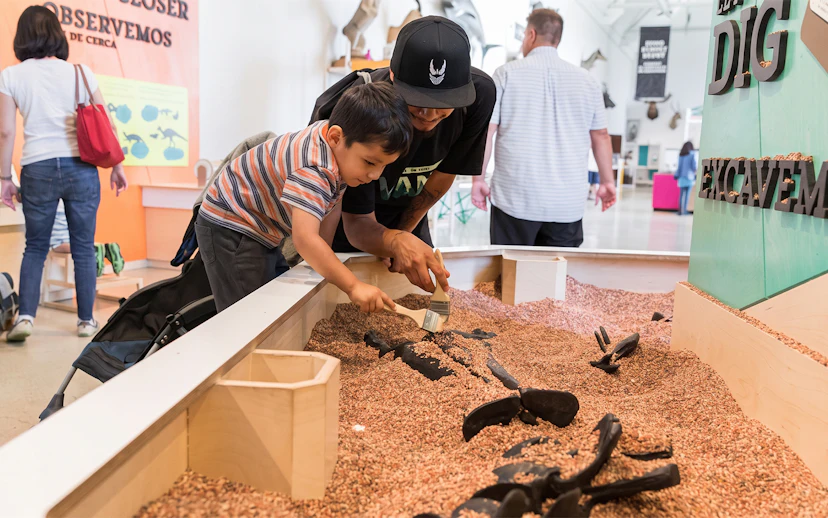
Nature Lab is the best reset if you need something more hands-on after a run of traditional gallery rooms. Microscopes, specimen stations, and live science activity make it especially good for families, but adults usually get more out of it than they expect. People often leave it to the end and run out of time, even though it is one of the easiest places to turn a good museum visit into a more memorable one.

Where to find it: Lower level near the entrance-side family spaces

Gnatalie and NHM Commons

Exhibit type: Outdoor-indoor entry experience

Gnatalie is worth treating as part of the museum, not just an arrival photo stop. The sculpture and the surrounding Commons space set the tone for the visit and help bridge the older building with the museum's newer public-facing identity. Many visitors walk straight through on the way to the ticket scan and never give themselves a minute to look up, orient, or enjoy the mural and plaza around it.

Where to find it: NHM Commons, before you enter the main historic building

Facilities and accessibility

  • 🎒 Bags: There are no on-site lockers, so bring only what you are comfortable carrying through the full visit.
  • 🚻 Restrooms: Standard, family, and all-gender restrooms are available on each level, which means you do not need to leave the museum route to find one.
  • 🍽️ Café: The café in NHM Commons is the easiest on-site food stop, but it closes before the museum day is fully over so late lunches are a bad bet.
  • 🛍️ Gift shop / merchandise: The main shop near the entrance is strongest for dinosaur, gem, science, and Los Angeles-themed gifts and books.
  • 🪑 Seating / rest areas: Benches are scattered through the larger halls, and the Family Lounge on Level 2 is the best place to reset with children.
  • 🅿️ Parking: The NHM garage is the simplest driving option and sits close to the entrance in Exposition Park.
  • 👶 Nursing rooms: Nursing rooms are available on Levels 1 and 2, which helps if you are planning a longer family visit.
  • ♿ Mobility: All permanent floors are accessible by elevator, wheelchairs are available free with an ID deposit, and the main limitation is that some seasonal outdoor pavilions are not fully accessible.
  • 👁️ Visual impairments: Service animals are welcome, and guest services can help direct you to tactile or orientation support available on site.
  • 🧠 Cognitive and sensory needs: Free sensory kits with items like noise-reducing headphones are available near guest services, and opening time on Monday or Tuesday is usually the calmest window.
  • 👨‍👩‍👧 Families and strollers: Strollers work well through the main museum route, but they are not permitted inside the seasonal Butterfly or Spider Pavilions.

This museum works especially well for children who like dinosaurs, animals, bugs, and hands-on science, and it is easiest with kids if you build the visit around a few big rooms instead of trying to cover everything.

  • 🕐 Time: 2-3 hours is realistic with young children, and Dinosaur Hall plus Nature Lab is the strongest short route.
  • 🏠 Facilities: Family restrooms, nursing rooms, elevators, and the Family Lounge make it easier to break up a longer indoor visit.
  • 💡 Engagement: Use the museum's free Dinosaur Hall tour or live science activity as your anchor because it gives kids a story to follow instead of just room-to-room walking.
  • 🎒 Logistics: Bring a small bag, arrive close to opening, and avoid bulky strollers if you think you may add seasonal pavilion experiences.
  • 📍 After your visit: The California Science Center and Exposition Rose Garden are the easiest child-friendly follow-ons without adding more transit.

Rules and restrictions

What you need to know before you go

  • Entry requirement: Timed or date-specific admission is the smoothest way in, and mobile tickets work at the entrance.
  • Bag policy: All bags go through security, there are no lockers, and anything bulky stays with you all day.
  • Re-entry policy: Same-day re-entry is allowed with your ticket, which makes it easier to step out for a break or pair the museum with Exposition Park.

Not allowed

  • 🚫 Food and drink: Outside food is not allowed inside the galleries, though a sealed water bottle is the easiest thing to carry without trouble.
  • 🚬 Smoking and vaping: Smoking and vaping are not permitted inside the museum.
  • 🐾 Pets: Pets are not allowed, but service animals are welcome.
  • 🖐️ Touching exhibits: Hands-off rules are strict because many displays are original fossils, specimens, or preserved collections.

Photography

Personal photography is generally allowed in the permanent galleries, which is good news because Dinosaur Hall and NHM Commons are some of the museum's most photogenic spaces. Flash, tripods, and commercial filming need more caution or permission, and temporary exhibitions can set tighter rules at their own entrances, so check the posted sign before you shoot.

Good to know

  • Extra-cost experiences: Seasonal pavilions, 3D films, and some temporary exhibitions can sit outside general admission, so check inclusions before you line up.
  • Closure pattern: The museum's first-Tuesday closure catches more visitors out than sold-out dates do, so check the calendar before you lock in transit plans.

Practical tips

  • Booking and arrival: Book ahead if you are visiting on a weekend or school-break date, then arrive 15-20 min early because timed tickets speed up entry but do not remove the security line.
  • Pacing: Go to Dinosaur Hall first if it is your priority, because it becomes the most crowded room fastest and feels much better before the late-morning rush builds.
  • Crowd management: Monday at opening is stronger than a random midweek late morning here, since Wednesday-Friday often bring field trips that fill the museum earlier than many adults expect.
  • What to bring or leave behind: Carry the smallest bag you can manage; there are no lockers, and a big backpack is one more thing to keep with you in crowded halls and through security.
  • Food and drink: Do not save lunch for the very end of your visit, because the on-site café closes before the museum day is done and outside food needs to stay outside the galleries.
  • With kids: Plan your energy around one big visual hall and one interactive stop, because children usually stay engaged much longer with a Dinosaur Hall plus Nature Lab pairing than with a full floor-by-floor sweep.
  • Route planning: Count NHM Commons as part of the visit, not just the entrance, or you will rush straight into the historic building and miss one of the easiest orientation points on site.

What else is worth visiting nearby?

Commonly Paired: California Science Center

Distance: about 200 m — 2-3 min walk
Why people combine them: It is the most natural same-day pairing in Exposition Park because you can move from natural history to space, technology, and hands-on science without needing another ride.
Book / Learn more

Commonly Paired: Exposition Rose Garden

Distance: about 150 m — 2 min walk
Why people combine them: It gives you an easy outdoor break before or after a museum visit, especially if you want somewhere calm to sit after a few hours indoors.
Book / Learn more

Also nearby

California African American Museum
Distance: about 400 m — 5 min walk
Worth knowing: It is a smart add-on if you want a lighter cultural stop after NHM without committing to another half-day attraction.

Los Angeles Memorial Coliseum
Distance: about 500 m — 6 min walk
Worth knowing: It is worth a quick detour for sports fans or anyone who wants a recognizable Los Angeles landmark before heading back out of Exposition Park.

Eat, shop and stay near Natural History Museum of Los Angeles County

  • On-site: The café in NHM Commons is the most convenient option for coffee, snacks, and a simple lunch, but it works better as a mid-visit reset than as a destination meal.
  • Exposition Park picnic lawns (2-min walk, Exposition Park): Best if you want fresh air and already know you will need a break outside because food does not come into the galleries.
  • California Science Center dining options (3-min walk, 700 Exposition Park Dr): Useful if you are pairing both museums and want the fastest nearby fallback without leaving the park.
  • USC Village dining area (12-min walk, Jefferson Blvd area): Better than staying inside the park if you want more choice or a more substantial meal before heading back downtown.
  • 💡 Pro tip: Eat before 12 noon or after 2pm if you can, because the museum's easiest food options are busiest in the middle of the day and close earlier than many visitors expect.
  • NHM Store: Best for dinosaur books, science gifts, gemstone souvenirs, and Los Angeles-themed museum merch right by the entrance.
  • USC Village retail: Better if you want practical extras or a wider range of shops after the museum rather than a gift-led stop.

Staying right by Exposition Park is convenient for a short museum-first morning, but it is not the most rounded base for most Los Angeles trips. The area works best if you want walkable access to the museum, California Science Center, and USC, but it is quieter at night and has less all-day traveler energy than better-known visitor neighborhoods.

  • Price point: The immediate area is mixed, with campus-adjacent hotels and practical chain stays rather than the broadest range of citywide options.
  • Best for: Visitors on a short trip who want to walk to the museum and keep logistics simple for a family or half-day plan.
  • Consider instead: Downtown Los Angeles or Koreatown usually works better for longer stays because you get more hotel choice, easier dining, and stronger transit links across the city.

Frequently asked questions about visiting Natural History Museum of Los Angeles County

Most visits take 3-4 hours. If you only want the biggest hits, you can cover NHM Commons, Dinosaur Hall, and Gem and Mineral Hall in about 2-2.5 hours, but a fuller first visit with Becoming Los Angeles and Nature Lab usually needs half a day.

More reads

NHM tickets

NHM highlights

Getting to NHM

Los Angeles guide